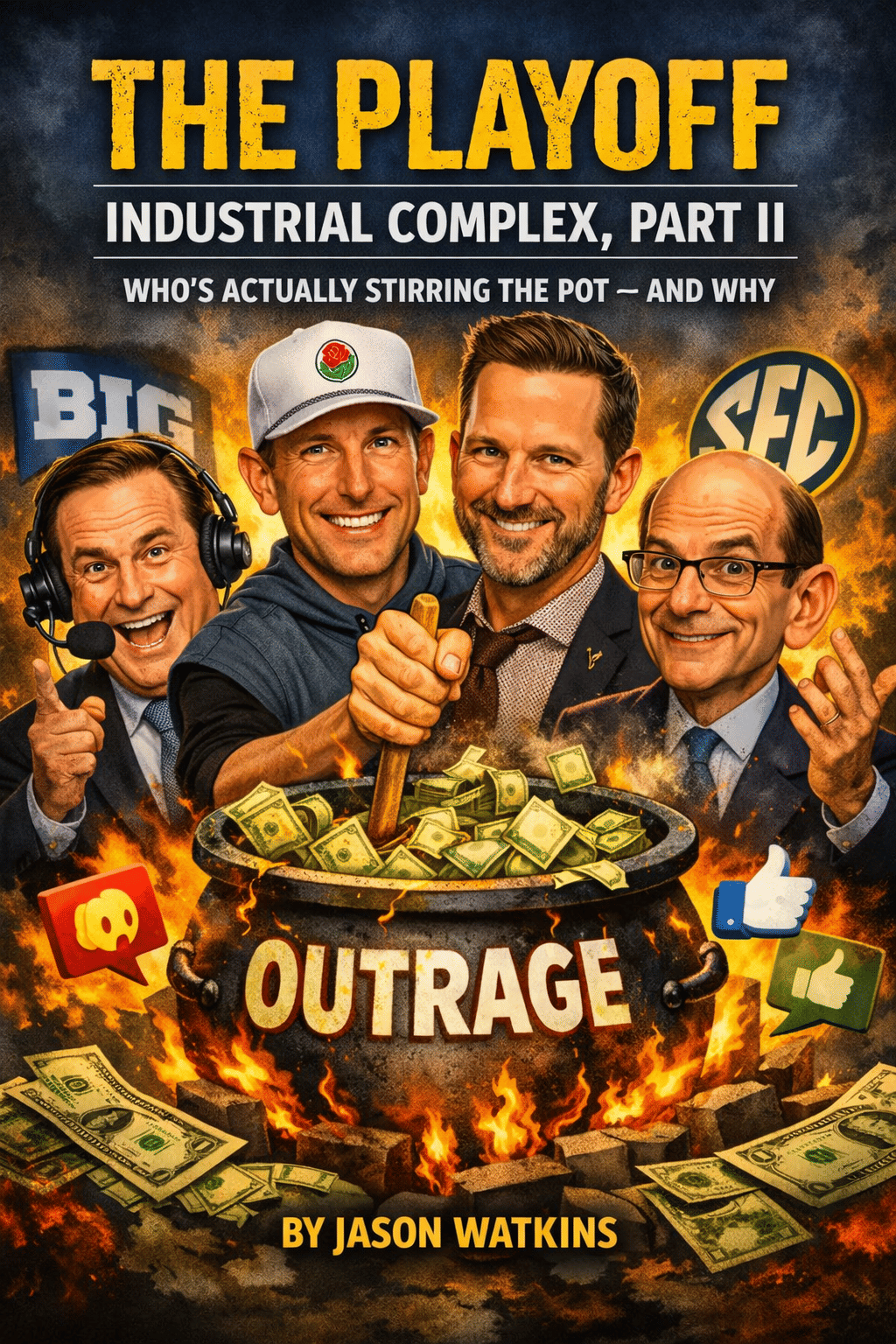
The Playoff Industrial Complex, Part II
Who’s Actually Stirring the Pot — and Why
One of the biggest reasons the College Football Playoff feels so toxic right now isn’t the format.
It’s not the committee.
It’s not even the results.
It’s the way a handful of loud, influential media personalities keep pouring gasoline on every fire — then pretending they’re just standing there watching it burn.
Let’s be honest about something too many people tiptoe around:
Not everyone covering college football is acting in good faith.
Some people are. Some people are trying to explain the sport, make sense of it and give fans a fair look at what’s happening.
And some people — whether they mean to or not — are playing a different game.
They’re not analyzing. They’re campaigning.
They’re not informing. They’re selling a story.
And that story almost always lines up with the brands, conferences and networks they’re tied to.
That’s not an accident.
This isn’t about “bias.” It’s about incentives.
Every major voice in college football today is connected to a network. Every network is connected to specific conferences. Every conference is fighting for relevance, money and playoff access.
So when someone goes on TV, radio, YouTube or X and pounds the table for a league — or against a league — it’s not happening in a vacuum.
It happens inside a business.
FOX has the Big Ten.
ESPN has the SEC, ACC and the majority of the Big 12.
NBC has Notre Dame.
That doesn’t mean everyone is lying. But it does mean nobody is neutral.
And when you combine that with social media — where outrage gets more clicks than nuance — you get exactly what we have now:
A sport that’s being argued about more than it’s being watched.
The difference between analysis and agitation
There’s a difference between saying:
“I think the Big Ten is strong this year.”
and
“The SEC is overrated, always has been and Alabama proved it with that farce at the Rose Bowl.”
There’s a difference between saying:
“I want G6 teams to have a path.”
and
“G6 teams deserve to be in the Playoff regardless of whether they’re actually one of the best teams.”
One is analysis.
The other is agitation.
And this is where the laziness really sets in.
The moment Alabama got run over by Indiana in the Rose Bowl, the takes wrote themselves. Not thoughtful ones. Not careful ones. Blanket ones.
“The Big Ten has replaced the SEC.”
“This proves the SEC is overrated.”
“The Big Ten is now the premier conference in college football.”
All because Indiana and Oregon moved on to the semifinals and guaranteed the league a third straight national title appearance.
That’s not analysis. That’s headline writing.
One result becomes proof of a complete power shift. One bad night becomes evidence that an entire league has been living a lie.
It’s easy. It’s emotional. And it’s wrong.
Let’s name some names (fairly)
Tim Brando
Tim Brando has become the loudest megaphone for the idea that Group of 6 teams are being “kept out” of the Playoff by some unfair system run by the SEC and ESPN.
Here’s the problem:
Brando isn’t just arguing for access. He’s arguing for lower standards and simultaneously taking a swipe at the league he used to announce games for (the SEC), while pretending the league he calls games for now (FOX) isn’t guilty of the same — supposed — sin.
James Madison played one Power 4 team in 2025 — Louisville — and lost by multiple scores.
Tulane lost by five touchdowns to Ole Miss before getting run again in the Playoff.
That doesn’t make them bad teams. It makes them unproven at the highest level.
There’s nothing unfair about saying:
“If you want in the Playoff, be one of the best teams.”
That’s not anti-G6. That’s pro-competition.
Joel Klatt
Joel Klatt is smart, informed and good at his job — but his framing almost always runs through a Big Ten lens.
When Big Ten teams win, it’s proof the league is elite.
When Big Ten teams lose, it’s an outlier.
When SEC teams win, it’s “brand bias.”
When SEC teams lose, it’s “exposure.”
That isn’t balance. That’s storytelling.
It turns analysis into marketing and marketing into “truth.”
Danny Kanell
Danny Kanell’s public identity now revolves around attacking the SEC and promoting anyone who isn’t the SEC.
He doesn’t react to events — he waits for events that fit the story he already wants to tell.
And once a narrative is in the air — like “the SEC has too many teams in the Playoff” — Kanell quickly joins the pinata party.
The Big Ten had three teams.
The ACC had one.
The Big 12 had one.
The SEC had five.
That imbalance is framed as favoritism, not scheduling, not depth and not week-to-week difficulty — but bias.
Which is convenient, because calling it bias is easier than explaining why your league didn’t produce more teams with better résumés.
Paul Finebaum
On the other side, Paul Finebaum has become the caricature version of the SEC megaphone.
He doesn’t explain the SEC anymore. He defends it.
He doesn’t contextualize criticism. He mocks it.
And that turns valid questions into punchlines, which only deepens resentment.
Different directions. Same problem.
The laziest takes in college football right now
“Look at the bowl records.”
The Big Ten is 7–2. The SEC is 3–7.
Sounds damning — until you look at the matchups.
Four of the Big Ten’s seven wins came against Group of 6 opponents.
The SEC didn’t play a single Group of 6 team.
LSU, 10th in the SEC, lost a close Texas Bowl to Big 12 fourth-place Houston — on the road in Houston.
Wake Forest beat a 5–7 Mississippi State team tied for 14th in the SEC.
Missouri, eighth in the SEC, narrowly lost to ACC runner-up Virginia.
Those aren’t apples-to-apples comparisons. They’re not even the same grocery store.
Also missing from the “overrated SEC” narrative:
Four of the five SEC playoff teams played each other.
Alabama beat Oklahoma.
Ole Miss beat Georgia.
Those aren’t cross-conference losses. Those are self-inflicted ones.
And quietly sitting behind all of this: the SEC went 13–3 against the rest of the Power 4 in non-conference play.
That’s not a reputation. That’s a record.
Where I draw the line on the Group of 6
I do not think G6 teams should be banned from CFP participation.
I do not think they should be disrespected.
I do not think they should be ignored.
I do think they should be held to the same standard.
If you’re one of the Top 12, you’re in.
If you’re not, you’re not.
That standard should apply to everyone.
Lowering the bar doesn’t create fairness. It just changes who benefits.
Why this matters
The danger isn’t that some people are wrong.
The danger is that the sport is losing its shared reality.
Every result becomes political. Every ranking becomes personal. Every champion becomes provisional.
That’s how sports stop being sports and start being culture war.
And that’s how you lose the one thing competition needs: agreement on what actually happened.
The real cost
The myth of neutral media is comforting. It lets fans outsource responsibility.
But the media isn’t neutral. It’s interested.
And fans have a choice.
They can treat commentary as gospel and outrage as evidence.
Or they can watch the games, understand the context and accept that complexity isn’t corruption.
The Playoff doesn’t need to be purified.
It needs to be understood and, yes, probably tweaked a bit.
But the first step toward understanding it is admitting that the people telling us what it means aren’t doing so from outside the system.
They’re standing on its payroll.
And when someone goes on TV, radio, YouTube or X and pounds the table for a league, or against a league, that doesn’t happen in a vacuum.
JASON WATKINS is the publisher and founder of HOF Media and the HOF College Football Show on YouTube. Write to him at jw@hofmedia.us.

The SEC transition has been harsher on Brent Venables and the Oklahoma Sooners than anticipated, with a tough 1-4 start sparking fan concerns over Venables’ leadership.
Despite glimpses of offensive progress in their latest 26-14 loss at Ole Miss, Oklahoma’s 4-4 record has fueled doubts about Venables’ ability to steer the program through the SEC’s relentless competition. While injuries to key offensive players have created challenges, Venables’ hesitance to address coaching issues and poor communication within the offensive staff have only deepened the Sooners' struggles.
The failure of the offensive staff to communicate effectively and Venables’ hesitance to manage his coaching staff proactively have compounded the difficulties presented by mounting injuries.
Hesitancy on Display: The 4th-Down Decision
Venables' hesitation was encapsulated on Saturday, just six days after finally relieving Littrell of his duties as offensive coordinator: the 4th-and-4 timeout against Ole Miss late in the third quarter. Trailing by two scores, Oklahoma needed a jolt to stay in the game.
The situation was critical, but hardly complex. Coaches make these calls instinctively, often without a second thought. Instead, Venables used a timeout — only to ultimately bring out the punt team, a decision that deflated the offense and left fans scratching their heads.
If the choice was to punt, Venables could’ve delayed the game for a mere five yards instead of burning a precious timeout. If he intended to go for it, why not get his new play caller’s best play for the situation and make the call confidently?
Even if the Sooners fail to pick up the four yards, it would have signaled a willingness to take a chance — or give one — to an offense that has been less-than-inspiring all season.
In that one instance, Venables’ hesitation was as costly as a missed play. With the momentum squarely in favor of Lane Kiffin’s Rebels, burning that timeout only to punt sent the wrong signal to a young group on offense that is in serious need of someone who believes in them. Instead, he proved he didn’t trust them to get a measly four yards and extend a drive to get back into the game.
OU’s Identity Crisis on Offense
What we’re witnessing with OU’s offense is not merely a slump — it’s an identity crisis. Oklahoma fans are accustomed to high-powered, fast-paced offenses that can score almost at will. Littrell’s offense was anything but explosive for seven weeks, and Joe Jon Finley had a lackluster, scoreless latter half of Week 8, too.
To say the Sooners struggled to establish consistency would be an overwhelming understatement.
OU has struggled with untimely penalties and turnovers and suffered through a complete lack of innovation and creativity. The plays feel uninspired, lack direction and are devoid of explosive results.
As a unit, this offense is drawing comparisons to the infamous John Blake era, and has the numbers to back the comparison up. ⬇️ ⬇️ ⬇️ ⬇️
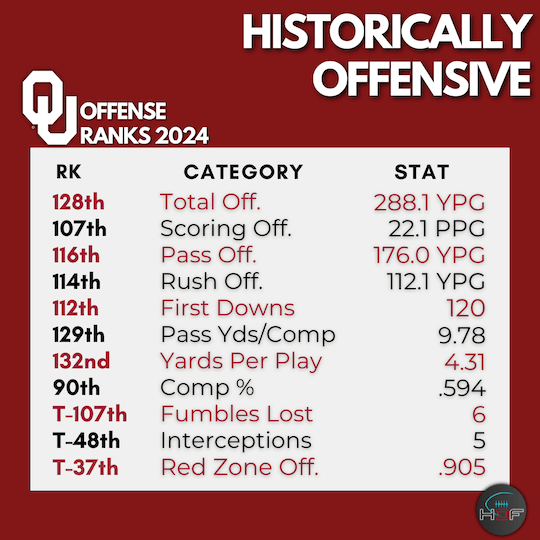
There’s no other way to say it but bluntly … OU has no clear identity with its offense on the field.
The offensive woes go beyond play-calling; they’re structural. Reports from inside the Switzer Center suggest that there have been significant communication breakdowns within the offensive staff. Coaches have reportedly been on different pages regarding even the most fundamental elements, like blocking schemes. If those rumors are reaching the public, it’s safe to say Venables has known about these issues for some time.
A head coach — even a defensive-minded one like Venables — cannot allow such dysfunction to persist. These aren’t minor misunderstandings; they’re symptoms of a team struggling to find cohesion. Venables needed to address these issues early, before they became embedded in the team’s culture, but his delay in doing so has turned what might have been small fires into an inferno.
Mailed-In Hire: The Problem with Littrell
When Venables hired Seth Littrell, it felt like a placeholder decision. It wasn’t the bold, visionary hire that programs like Oklahoma should be making. Littrell’s track record showed some promise, but he had yet to prove himself as the kind of offensive mind that could elevate a program to championship contention.
Looking back on the decision to elevate Littrell and Finley, the hire seems more like an afterthought, a half-measure rather than a commitment to offensive excellence.
The results have been glaringly obvious. The offense lacks explosive creativity that OU fans are used to seeing, and that lack of energy has translated into downright unacceptable performances on the field, as evidenced by the Sooners’ historically bad statistical rankings in FBS football.
In just ten months on the job, Littrell and his offensive staff failed to the tune of numbers nobody in their right minds would have predicted following the Sooners’ 2023 season that saw the offense rank in the Top 5 in both Total Offense and Scoring Offense, and alone at the top of the Big 12 Conference in Points, Yards and Yards Per Play.
This despite having two of the most electric quarterbacks from their respective recruiting classes in the fold:
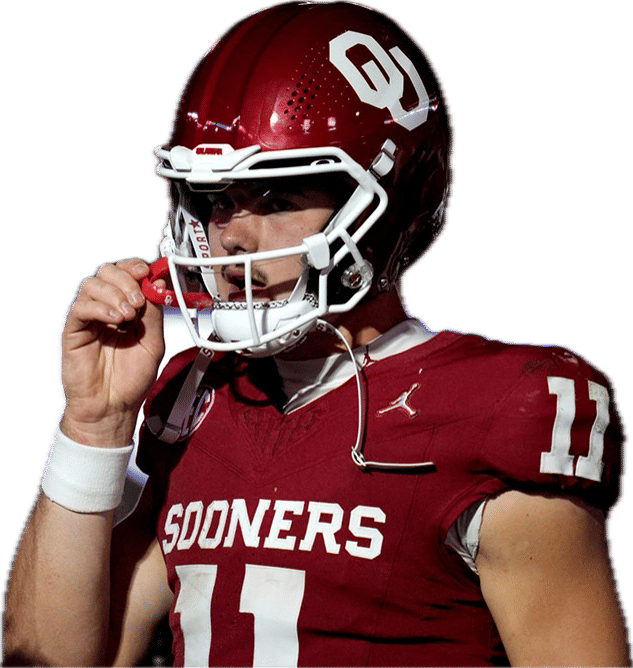
2023 5-star and Elite 11-winning Jackson Arnold of Denton Guyer, the 2023 Gatorade National HS Player of the Year and twice a Class 6A State Finalist in Texas.
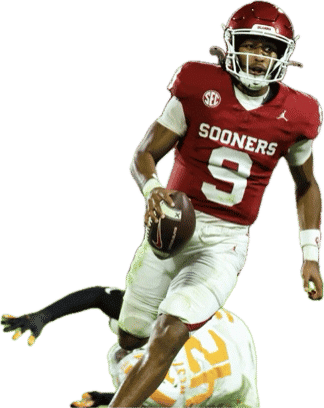
And former Allen and Frisco Emerson (Texas) superstar Michael Hawkins, Jr., a Sooner legacy trained by Kyler's father Kevin Murray, and who, as a senior, accounted for 55 touchdowns and just three turnovers, leading Emerson to within a game of playing for a Texas State Championship in Class 5A.
Neither were able to sustain success under Littrell's tutelage, and rumors have swirled this week about none of OU's QBs feeling as though been properly developed by the now-fired Littrell as the QBs coach.
Both started a games after being inserted for the other following ineffective play, and both came into their first appearances under Littrell with confidence and swagger that appeared missing by the time they were pulled from games after committing three turnovers and allowing the Sooners to fall behind teams they likely could have beaten were it not for the turnovers they committed.
In other words, Seth Littrell had to go.
Saturday’s loss leaves Oklahoma at 4-4, staring down a potential losing season -- the second for Venables since he arrived after the abrupt departure of Lincoln Riley to USC.
These are unacceptable at Oklahoma, a school with one of the richest football traditions in the country. What makes it even more alarming is that no longer can OU fans blame the losses on a ineffectice, suoddr defense — OU seems to have mostly turned the corner on that side of the ball — but to say the fan base is frustrated, would again be a massive understatement.
Oklahoma fans don’t want excuses; they want results. And for a head coach like Venables, the time for excuses is running out.
The Next OC Hire: BV’s Defining Moment
After Finally punting the Littrell experiment — once again needing more time than most believe he should have — Venables again finds himself in the market for a new offensive coordinator — for the third time in three seasons.
This time, though, the choice Venables makes will ultimately define his second tenure in Norman, possibly his entire future as a head coach in college football. Mailing it in would be tantamount to a dereliction of duty in the eyes of Sooner Nation.
Venables MUST get this one right. He has to bring in someone with a proven track record of offensive success, someone who can bring energy, innovation, and a clear identity to the offense. Anything less than a home-run hire will only deepen the cracks in Venables’ foundation as head coach.
If Venables fails to find the right offensive coordinator, his job security will slip through those cracks, and his tenure as the Head Ball Coach of the Sooners will die in a whimper. Even if he builds a defense that resembles the ’85 Bears, it won’t matter if OU’s offense can’t score points.
The OU fan base is patient to a degree, but they expect excellence. For Venables, this is a make-or-break moment.
Either he finds the right offensive coordinator and proves he can lead a balanced, championship-caliber team, or he risks being shown the door in a year or less.
The Venables Paradox: Championship Defense, JV Offense
The irony of Venables’ situation is that, in many ways, Oklahoma has become Lincoln Riley’s reverse image. Under Riley, the Sooners fielded prolific offenses but were plagued by a porous defense that could never quite get them over the championship hump.
With Venables, it’s the opposite: the defense has shown promise, but the offense is currently in full-on spiral.
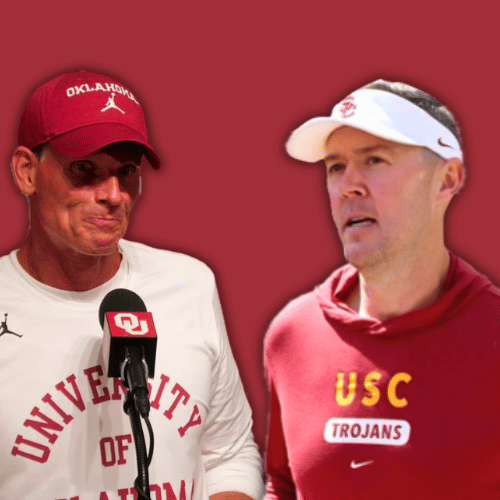
The head coach role, especially at Blue Blood OU, requires more than defensive expertise or recruiting prowess. It demands a complete vision, a well-rounded team, and an unwavering commitment to excellence on both sides of the ball.
For Venables to truly establish himself as a championship-level head coach, he has to be willing to delegate offense to someone who can make people forget he’s a defensive guru and simply call him “Coach.” To reach the heights that Oklahoma fans demand, Venables needs to be remembered not as a defensive mind but as a leader who fields a complete team. That requires taking risks, making tough decisions, and, most importantly, holding his staff to the highest possible standard.
It requires a decisive, confident vision for a championship future. The clock is ticking on Brent Venables’ tenure in Oklahoma, and his window for turning things around is narrowing.
Being the head coach at Oklahoma is an honor, but it’s also a responsibility. Venables needs to rise to that responsibility, or he and Lincoln Riley might both be in the job market this time next year.
________________
Jason Watkins is the Publisher at HOF Media Group and the Host of the HOF College Football Podcast. Reach him at jw@hofmedia.us