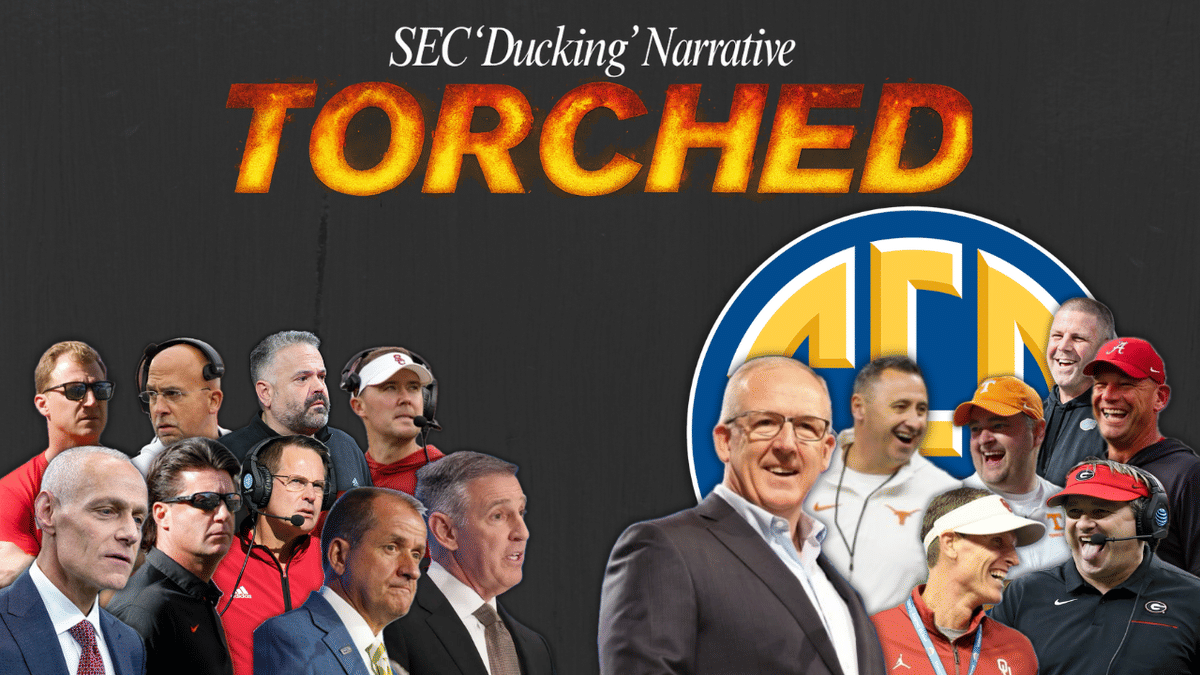
Two truths—both valid—are staring us in the face. The SEC didn’t flip to a nine-game schedule for ESPN’s $5 million trinket. It did it to protect rivalries and to lean into the playoff’s new strength-of-schedule metrics.
And just like that, the half-hearted straw man about the SEC “ducking competition” under its long-standing 8-game slate?
Gone. Torched. Dead.
For years, it’s been the favorite security blanket of Big Ten country—a lazy narrative that played well on Midwest talk radio—and the rallying cry at truck stops across the Big 12. “The SEC’s afraid to play nine!” they screamed, while scheduling MACtion homecomings and Conference USA body bags to pad their own records.
But here we are. The SEC went to nine. Rivalries are safe. The gauntlet got tougher. And now the league that was accused of hiding from competition has strapped on extra weight plates, leaving its critics holding an empty bag.
What excuse is left? That the SEC will somehow still get “too much credit” when four or five of its teams make the playoff—because strength of schedule now matters more than inflated win totals? Please. That’s not bias—that’s math.
Rivalries: The Soul of the Game
College football is nothing without its rivalries. It’s where tribal hatred lives and thrives.
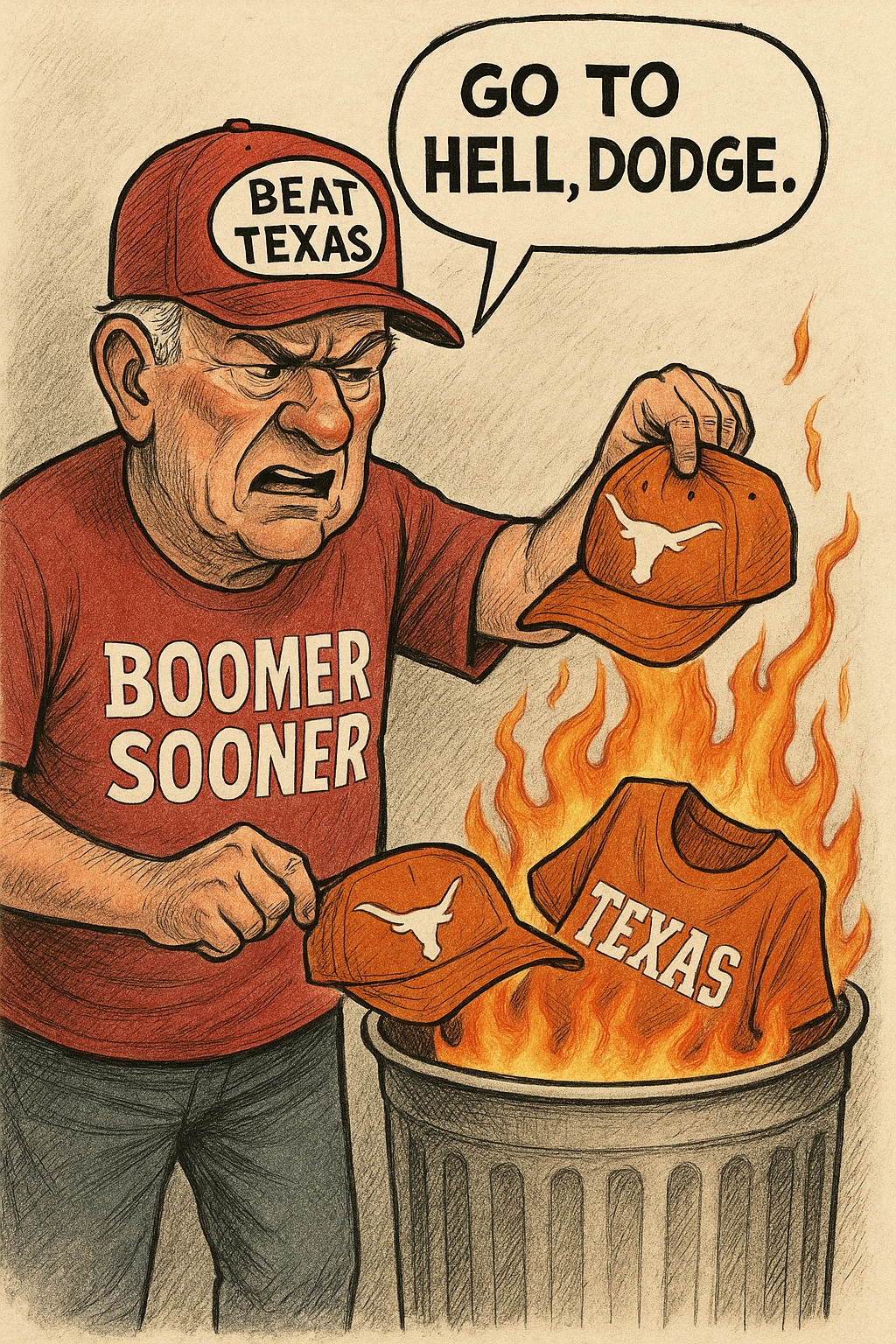
It’s why your dad lights a pile of burnt-orange Texas hats in the backyard every August, still cursing the refs who robbed Oklahoma of Keith Stanberry’s interception against Todd Dodge in 1984.
It’s why families intentionally sit on opposite sides of the aisle at the Iron Bowl. It’s why your uppity Ole Miss uncle storms out of Thanksgiving dinner with a black eye—after telling your aunt, the former Mississippi State cheerleader, that Jaxon Dart was better than Dak Prescott.
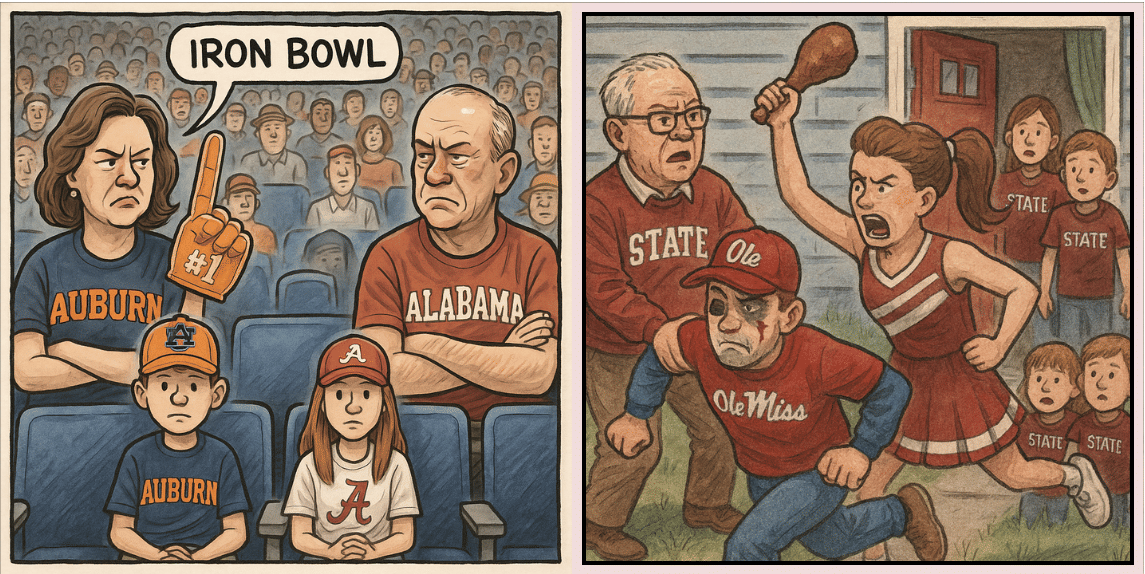
Without the ninth game, those kinds of annual matchups were in danger. Auburn vs. Georgia—the Deep South’s Oldest Rivalry—was on life support. Texas vs. Texas A&M—the Lone Star Showdown—might’ve slipped back into “occasional” status. Even Alabama vs. Tennessee, the Third Saturday in October, wasn’t safe.
Now? Each SEC team gets three protected opponents. Sankey himself said the format “protects rivalries, increases competitive balance, and bolsters readiness for the College Football Playoff.”
So yes—rivalries matter. But they aren’t the whole story.
Strength of Schedule: The Steak, Not the Sizzle
Here’s the real reason the SEC flipped: strength of schedule.
The CFP committee just rolled out new metrics—“record strength” and heavier SOS weighting. Translation: it’s no longer just about how many games you won, but who you beat and how tough they were.
That’s where the SEC lives.
15 of the last 20 national champions.
Mid-tier SEC programs still recruit Top-20 classes.
The NFL Draft is a yearly SEC infomercial.
Take away the emotion, and the raw numbers scream dominance. When SOS becomes king, the SEC is the crown jewel.
The Big Ten can wave its two-title streak around, but that makes three in the last two decades. The SEC’s at fifteen. There’s no comparison.
The Two Truths, Unified
So let’s be clear:
It’s not about the $5 million. That’s pocket change.
It is about rivalries. They’re the soul of the sport.
It is about playoff leverage. SOS now rewards the SEC for playing the gauntlet.
Win. Win. Double win.
Narrative vs. Reality: Tossing the Talking Points
The naysayers love screaming “SEC bias” or “SEC circle jerk.” They’ll point to two Big Ten titles, a few bowl wins, or flashy hires and call it proof the SEC isn’t superior.
Cute. But two trophies don’t erase 15 SEC championships in 20 years. The Big Ten has just three in that span. That mountain isn’t shrinking—it’s getting taller.
And now the SEC adds Oklahoma (7 titles) and Texas (4, plus back-to-back CFP semifinal runs). Both recruit at an elite level. Every SEC program already mandates a Power opponent out-of-conference. That’s not spin—that’s muscle.
This isn’t favoritism. It’s dominance. And if you’re smart, you don’t whine about it—you schedule it. Because even a competitive loss to an SEC team boosts your résumé more than stacking cheap wins against cupcakes.
Structure Efficiency: Game Balance and Fairness
The new SEC format is simple and effective.
Three permanent rivalries.
Six rotating games.
No divisions.
Every opponent faced once every two years, home-and-away in four.
That’s cleaner than the Big Ten’s “protected pods” mess and fairer than the ACC’s semi-coherent rotation. And the requirement for SEC teams to keep scheduling a high-quality non-con game every year? That’s not fluff—it’s strategic arms-building.
Conclusion: The SEC Plays Smart
Here’s the bottom line:
The $5 million from ESPN? Cute. Doesn’t move the needle.
Rivalries? Sacred. Now secured.
Strength of schedule? That’s the power play, and the SEC owns it.
Two truths, side by side. Don’t let anyone divide them.
Nine-game schedules were never the flex the Big Ten and Big 12—and even the 8-game ACC—pretended they were during media days. Deep down, those leagues knew exactly who runs the sport.
And let’s be real here: all those loud Big Ten coaches—Lincoln Riley, Matt Rhule, Curt Cignetti—who love to cry about fairness while scheduling cupcakes out of conference? Guess what—your excuse is gone. The SEC’s playing nine now.
Put up or shut up.
Same goes for the Big 12, where Mediocre Mike Gundy is calling out people in his own fan base who “can’t pay their own bills,” while finishing 0-9 in the conference immediately upon Big Brother OU’s departure.
Sorry, Mike—your “more with less” narrative is no longer fooling anyone.
On Thursday, the SEC didn’t just go to nine games. It beat the other three leagues over the head with a reminder:
THIS is the alpha conference. It has the players, the rivalries, the recruiting, the draft picks, the money, and now the playoff leverage.
This isn’t mudslinging—it’s business. And business has been booming in the SEC for twenty years, while everybody else is still trying to catch up.
––––
Jason Watkins is the founder and managing editor of HOF Media Group and the HOF College Football YouTube channel. He can be reached at jw@hofmedia.us.

The SEC transition has been harsher on Brent Venables and the Oklahoma Sooners than anticipated, with a tough 1-4 start sparking fan concerns over Venables’ leadership.
Despite glimpses of offensive progress in their latest 26-14 loss at Ole Miss, Oklahoma’s 4-4 record has fueled doubts about Venables’ ability to steer the program through the SEC’s relentless competition. While injuries to key offensive players have created challenges, Venables’ hesitance to address coaching issues and poor communication within the offensive staff have only deepened the Sooners' struggles.
The failure of the offensive staff to communicate effectively and Venables’ hesitance to manage his coaching staff proactively have compounded the difficulties presented by mounting injuries.
Hesitancy on Display: The 4th-Down Decision
Venables' hesitation was encapsulated on Saturday, just six days after finally relieving Littrell of his duties as offensive coordinator: the 4th-and-4 timeout against Ole Miss late in the third quarter. Trailing by two scores, Oklahoma needed a jolt to stay in the game.
The situation was critical, but hardly complex. Coaches make these calls instinctively, often without a second thought. Instead, Venables used a timeout — only to ultimately bring out the punt team, a decision that deflated the offense and left fans scratching their heads.
If the choice was to punt, Venables could’ve delayed the game for a mere five yards instead of burning a precious timeout. If he intended to go for it, why not get his new play caller’s best play for the situation and make the call confidently?
Even if the Sooners fail to pick up the four yards, it would have signaled a willingness to take a chance — or give one — to an offense that has been less-than-inspiring all season.
In that one instance, Venables’ hesitation was as costly as a missed play. With the momentum squarely in favor of Lane Kiffin’s Rebels, burning that timeout only to punt sent the wrong signal to a young group on offense that is in serious need of someone who believes in them. Instead, he proved he didn’t trust them to get a measly four yards and extend a drive to get back into the game.
OU’s Identity Crisis on Offense
What we’re witnessing with OU’s offense is not merely a slump — it’s an identity crisis. Oklahoma fans are accustomed to high-powered, fast-paced offenses that can score almost at will. Littrell’s offense was anything but explosive for seven weeks, and Joe Jon Finley had a lackluster, scoreless latter half of Week 8, too.
To say the Sooners struggled to establish consistency would be an overwhelming understatement.
OU has struggled with untimely penalties and turnovers and suffered through a complete lack of innovation and creativity. The plays feel uninspired, lack direction and are devoid of explosive results.
As a unit, this offense is drawing comparisons to the infamous John Blake era, and has the numbers to back the comparison up. ⬇️ ⬇️ ⬇️ ⬇️
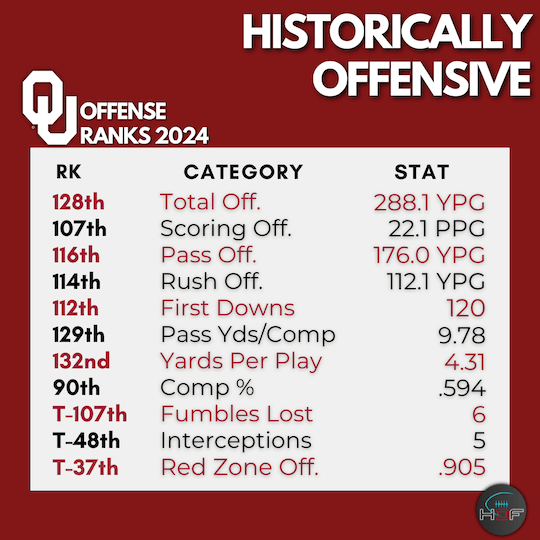
There’s no other way to say it but bluntly … OU has no clear identity with its offense on the field.
The offensive woes go beyond play-calling; they’re structural. Reports from inside the Switzer Center suggest that there have been significant communication breakdowns within the offensive staff. Coaches have reportedly been on different pages regarding even the most fundamental elements, like blocking schemes. If those rumors are reaching the public, it’s safe to say Venables has known about these issues for some time.
A head coach — even a defensive-minded one like Venables — cannot allow such dysfunction to persist. These aren’t minor misunderstandings; they’re symptoms of a team struggling to find cohesion. Venables needed to address these issues early, before they became embedded in the team’s culture, but his delay in doing so has turned what might have been small fires into an inferno.
Mailed-In Hire: The Problem with Littrell
When Venables hired Seth Littrell, it felt like a placeholder decision. It wasn’t the bold, visionary hire that programs like Oklahoma should be making. Littrell’s track record showed some promise, but he had yet to prove himself as the kind of offensive mind that could elevate a program to championship contention.
Looking back on the decision to elevate Littrell and Finley, the hire seems more like an afterthought, a half-measure rather than a commitment to offensive excellence.
The results have been glaringly obvious. The offense lacks explosive creativity that OU fans are used to seeing, and that lack of energy has translated into downright unacceptable performances on the field, as evidenced by the Sooners’ historically bad statistical rankings in FBS football.
In just ten months on the job, Littrell and his offensive staff failed to the tune of numbers nobody in their right minds would have predicted following the Sooners’ 2023 season that saw the offense rank in the Top 5 in both Total Offense and Scoring Offense, and alone at the top of the Big 12 Conference in Points, Yards and Yards Per Play.
This despite having two of the most electric quarterbacks from their respective recruiting classes in the fold:
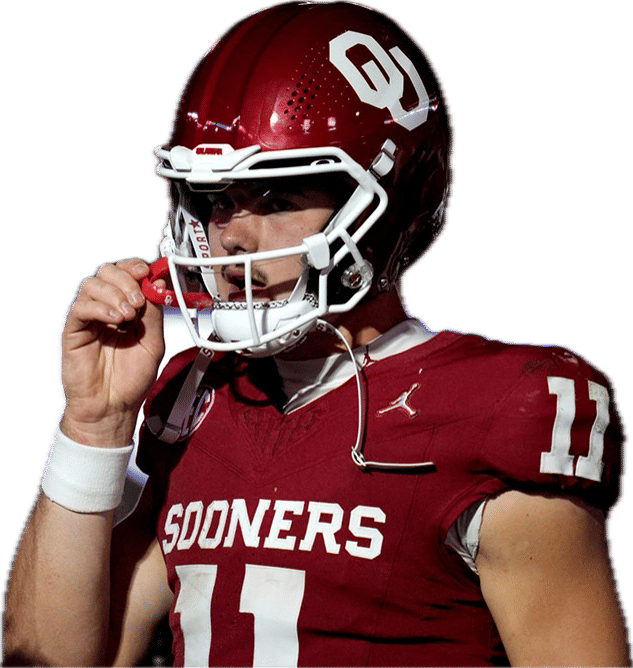
2023 5-star and Elite 11-winning Jackson Arnold of Denton Guyer, the 2023 Gatorade National HS Player of the Year and twice a Class 6A State Finalist in Texas.

And former Allen and Frisco Emerson (Texas) superstar Michael Hawkins, Jr., a Sooner legacy trained by Kyler's father Kevin Murray, and who, as a senior, accounted for 55 touchdowns and just three turnovers, leading Emerson to within a game of playing for a Texas State Championship in Class 5A.
Neither were able to sustain success under Littrell's tutelage, and rumors have swirled this week about none of OU's QBs feeling as though been properly developed by the now-fired Littrell as the QBs coach.
Both started a games after being inserted for the other following ineffective play, and both came into their first appearances under Littrell with confidence and swagger that appeared missing by the time they were pulled from games after committing three turnovers and allowing the Sooners to fall behind teams they likely could have beaten were it not for the turnovers they committed.
In other words, Seth Littrell had to go.
Saturday’s loss leaves Oklahoma at 4-4, staring down a potential losing season -- the second for Venables since he arrived after the abrupt departure of Lincoln Riley to USC.
These are unacceptable at Oklahoma, a school with one of the richest football traditions in the country. What makes it even more alarming is that no longer can OU fans blame the losses on a ineffectice, suoddr defense — OU seems to have mostly turned the corner on that side of the ball — but to say the fan base is frustrated, would again be a massive understatement.
Oklahoma fans don’t want excuses; they want results. And for a head coach like Venables, the time for excuses is running out.
The Next OC Hire: BV’s Defining Moment
After Finally punting the Littrell experiment — once again needing more time than most believe he should have — Venables again finds himself in the market for a new offensive coordinator — for the third time in three seasons.
This time, though, the choice Venables makes will ultimately define his second tenure in Norman, possibly his entire future as a head coach in college football. Mailing it in would be tantamount to a dereliction of duty in the eyes of Sooner Nation.
Venables MUST get this one right. He has to bring in someone with a proven track record of offensive success, someone who can bring energy, innovation, and a clear identity to the offense. Anything less than a home-run hire will only deepen the cracks in Venables’ foundation as head coach.
If Venables fails to find the right offensive coordinator, his job security will slip through those cracks, and his tenure as the Head Ball Coach of the Sooners will die in a whimper. Even if he builds a defense that resembles the ’85 Bears, it won’t matter if OU’s offense can’t score points.
The OU fan base is patient to a degree, but they expect excellence. For Venables, this is a make-or-break moment.
Either he finds the right offensive coordinator and proves he can lead a balanced, championship-caliber team, or he risks being shown the door in a year or less.
The Venables Paradox: Championship Defense, JV Offense
The irony of Venables’ situation is that, in many ways, Oklahoma has become Lincoln Riley’s reverse image. Under Riley, the Sooners fielded prolific offenses but were plagued by a porous defense that could never quite get them over the championship hump.
With Venables, it’s the opposite: the defense has shown promise, but the offense is currently in full-on spiral.
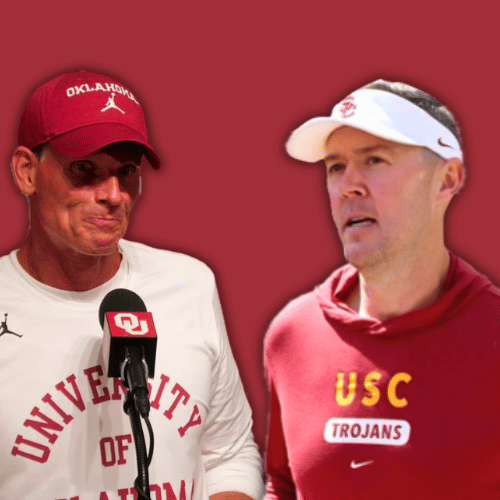
The head coach role, especially at Blue Blood OU, requires more than defensive expertise or recruiting prowess. It demands a complete vision, a well-rounded team, and an unwavering commitment to excellence on both sides of the ball.
For Venables to truly establish himself as a championship-level head coach, he has to be willing to delegate offense to someone who can make people forget he’s a defensive guru and simply call him “Coach.” To reach the heights that Oklahoma fans demand, Venables needs to be remembered not as a defensive mind but as a leader who fields a complete team. That requires taking risks, making tough decisions, and, most importantly, holding his staff to the highest possible standard.
It requires a decisive, confident vision for a championship future. The clock is ticking on Brent Venables’ tenure in Oklahoma, and his window for turning things around is narrowing.
Being the head coach at Oklahoma is an honor, but it’s also a responsibility. Venables needs to rise to that responsibility, or he and Lincoln Riley might both be in the job market this time next year.
________________
Jason Watkins is the Publisher at HOF Media Group and the Host of the HOF College Football Podcast. Reach him at jw@hofmedia.us