The Playoff Industrial Complex, Part I
How the College Football Playoff Became Content Instead of Competition

The College Football Playoff is not divisive because it is unfair. It is divisive because division has become one of its most valuable commercial products.
That is a subtle but crucial distinction — and one that gets lost every December and January as fans, media personalities and entire conferences turn the selection process and its aftermath into a rolling outrage cycle. What used to be a competition with debate attached to it has become a debate with a competition attached to it.
The games, in many ways, now exist primarily as fuel for the arguments. Nowhere has that been clearer than in the last 24 hours.
Top-seeded Indiana obliterated ninth-seeded Alabama 38–3 in the Rose Bowl on Thursday, a result that instantly triggered a predictable social media stampede. Within minutes, fans of teams and conferences left out of the 12-team field — most loudly Notre Dame, BYU and Utah supporters — were waving the score around like a smoking gun.
See? Alabama never belonged. Oklahoma never belonged. The SEC is overrated. The system is broken.
But that reaction says far more about how the Playoff is now consumed than it does about who actually belonged.
The Playoff didn’t suddenly become unfair because Alabama lost badly to a better team. The Playoff became a content machine in which every result is retroactively weaponized to validate pre-existing narratives, and every narrative is amplified by people and institutions who benefit financially from the outrage.
The product is no longer just football. The product is the fight about football.
The shift nobody talks about
The Playoff itself hasn’t fundamentally changed. It has always been subjective. The selection committee has always weighed a blend of résumé, strength of schedule, conference championships, head-to-head results, injuries, game control and the reality that not all schedules or leagues are created equal. That tension has always been part of the system.
What has changed is the environment around it.
The Playoff used to be the thing people argued about. Now the argument is the thing people watch.
Selection shows are staged like reality television. “Snubs” are teased before they are even defined. Graphics are built to provoke rather than explain. Panels are assembled not to clarify the process but to clash over it. The games themselves increasingly feel like the punctuation marks at the end of a much longer media sentence.
That’s not accidental. That’s business.
Outrage drives engagement. Engagement drives advertising. Advertising drives rights fees. Rights fees drive conference realignment, scheduling decisions and ultimately the structure of the sport itself.
In that ecosystem, clarity is bad for business. Confusion is profitable. Anger is monetizable. Tribalism is sticky.
So when Indiana beats Alabama by five touchdowns, the story isn’t “Indiana is excellent.” It’s “This proves Alabama never belonged.” When Oklahoma loses to Alabama, which then loses to Indiana, the story becomes “This proves the SEC is fraudulent,” rather than “This is how single-elimination tournaments work when elite teams collide.”
The logic isn’t football logic. It’s content logic.
Fans as content, not customers
In the modern college football economy, fans are no longer just the audience. They are the raw material.
Every angry tweet, every quote-tweeted clip, every rage-filled Reddit thread becomes unpaid promotional labor for the very entities shaping the narrative. The networks, the leagues and the personalities who dominate the discourse do not need to convince you of their position. They just need you to repeat it loudly.
That’s why old video clips resurface at exactly the right moments. That’s why commentary framed months earlier gets re-circulated after a game to serve as narrative “proof.” That’s why debates are rarely resolved — only refreshed.
In the wake of Indiana’s win, clips of commentators who had criticized the SEC earlier in the season were suddenly everywhere again, not because they added insight, but because they added gasoline. The message wasn’t analysis. It was affirmation.
You were right to be mad. You were right to feel cheated. You were right to think this was rigged.
That is the emotional transaction now being sold.
The myth of neutral media
This all rests on a polite fiction that no longer deserves to survive: the idea that the people shaping college football discourse are neutral observers.
They are not.
ESPN holds the SEC and ACC media rights and a majority share of the Big 12 package, while FOX holds the Big Ten and a smaller portion of Big 12 rights. CBS and NBC are invested in Big Ten inventory, with NBC holding exclusive rights to independent Notre Dame’s home games.
Every major broadcaster covering the sport is simultaneously its narrator, its distributor, its marketer and its business partner.
That doesn’t make them evil. It makes them interested.
It means their incentives are structural, not personal. It means the leagues they are financially tied to are the leagues they will, consciously or not, frame most favorably. It means storylines that elevate their properties will be emphasized, and storylines that undermine them will be contextualized, softened or redirected.
This is not a conspiracy. It is a business model.
And it means fans arguing over whether ESPN is biased toward the SEC or FOX is biased toward the Big Ten are missing the larger point: everyone is biased, because everyone is invested.
There is no neutral ground when billions of dollars are at stake.
Weaponized resentment
The most corrosive effect of this environment is how it reshapes fan identity.
Fans no longer simply root for teams. They root for conferences. They root for networks. They root for narratives. They adopt grievance as identity, and identity as argument.
BYU fans aren’t just mad their team missed the Playoff. They’re mad on behalf of the Big 12. Utah fans aren’t just disappointed. They are aggrieved. Notre Dame fans aren’t just frustrated by the structure. They feel targeted by it. SEC fans aren’t just defensive. They feel besieged.
And all of it feels personal because it has been made personal.
When Alabama loses badly, that loss is not allowed to be just a loss. It becomes evidence in a trial that never ends.
When Indiana dominates, it’s not simply a great team having a great game against a worthy opponent. It’s a political statement about league strength, resource distribution, fairness and legitimacy.
Football becomes secondary. Validation becomes primary.
That is how fans end up arguing about whether teams “belonged” after the games have already been played — as if worthiness is not something tested on the field, but something awarded retroactively by consensus.
It is a mindset that makes every outcome unstable and every conclusion provisional. Nothing is allowed to simply be true.
The Indiana–Alabama–BYU case study
Indiana’s win over Alabama should have been a celebration of an extraordinary team. Curt Cignetti’s Hoosiers, long the butt of college football jokes, won the Big Ten, beat Ohio State, earned the top seed and then validated it emphatically on the biggest stage.
Instead, much of the national conversation immediately became about who shouldn’t have been there.
That reflex is revealing.
BYU finished its season beating Georgia Tech in the Pop-Tarts Bowl. Utah beat Nebraska. Both are good wins. Neither retroactively transforms a résumé that included not qualifying for a conference championship or losing decisively in one.
Neither suddenly outweighs Alabama playing and beating a far more demanding schedule across three months. If the Florida State loss in Week 1 wasn’t egregious enough for most level-headed onlookers to dismiss a one-loss run through a brutal SEC season and deny the Crimson Tide a bid in the playoff, then getting blown out by Indiana can’t be either.
Yet in the outrage economy, that context is irrelevant. Only contrast matters. Indiana 38, Alabama 3 becomes not a story about Indiana, but a cudgel to swing at Alabama, Oklahoma and the SEC.
And that’s not analysis. It’s grievance maintenance.
Why this is bad for the sport
This environment erodes trust in the competition itself.
If every selection is framed as illegitimate, fans stop believing in the process. If every result is framed as proof of fraud rather than proof of performance, fans stop believing in the field. If every outcome is reduced to conference politics, fans stop believing the games matter on their own terms.
Eventually, the sport becomes less about excellence and more about validation.
And that is a far more dangerous place for college football to live than any flawed selection system ever could be.
The real villain
The villain here is not Alabama. It is not Indiana. It is not BYU. It is not the SEC, the Big Ten or the Playoff committee.
The villain is a media economy that has learned to profit from polarization and now has no incentive to stop.
The College Football Playoff did not become political on its own. It was made political because conflict is more profitable than clarity, outrage is more lucrative than honesty, and division is easier to sell than complexity.
Fans are not wrong to care. They are wrong to think the fight is with each other.
The tragedy is not that people are angry. It’s that they’re angry in exactly the direction that keeps the machine running.
And that, more than any seed or snub or blowout, is what’s actually broken.
JASON WATKINS is the publisher and founder of HOF Media and the HOF College Football Show on YouTube. Write to him at jw@hofmedia.us.
The SEC transition has been harsher on Brent Venables and the Oklahoma Sooners than anticipated, with a tough 1-4 start sparking fan concerns over Venables’ leadership.
Despite glimpses of offensive progress in their latest 26-14 loss at Ole Miss, Oklahoma’s 4-4 record has fueled doubts about Venables’ ability to steer the program through the SEC’s relentless competition. While injuries to key offensive players have created challenges, Venables’ hesitance to address coaching issues and poor communication within the offensive staff have only deepened the Sooners' struggles.
The failure of the offensive staff to communicate effectively and Venables’ hesitance to manage his coaching staff proactively have compounded the difficulties presented by mounting injuries.
Hesitancy on Display: The 4th-Down Decision
Venables' hesitation was encapsulated on Saturday, just six days after finally relieving Littrell of his duties as offensive coordinator: the 4th-and-4 timeout against Ole Miss late in the third quarter. Trailing by two scores, Oklahoma needed a jolt to stay in the game.
The situation was critical, but hardly complex. Coaches make these calls instinctively, often without a second thought. Instead, Venables used a timeout — only to ultimately bring out the punt team, a decision that deflated the offense and left fans scratching their heads.
If the choice was to punt, Venables could’ve delayed the game for a mere five yards instead of burning a precious timeout. If he intended to go for it, why not get his new play caller’s best play for the situation and make the call confidently?
Even if the Sooners fail to pick up the four yards, it would have signaled a willingness to take a chance — or give one — to an offense that has been less-than-inspiring all season.
In that one instance, Venables’ hesitation was as costly as a missed play. With the momentum squarely in favor of Lane Kiffin’s Rebels, burning that timeout only to punt sent the wrong signal to a young group on offense that is in serious need of someone who believes in them. Instead, he proved he didn’t trust them to get a measly four yards and extend a drive to get back into the game.
OU’s Identity Crisis on Offense
What we’re witnessing with OU’s offense is not merely a slump — it’s an identity crisis. Oklahoma fans are accustomed to high-powered, fast-paced offenses that can score almost at will. Littrell’s offense was anything but explosive for seven weeks, and Joe Jon Finley had a lackluster, scoreless latter half of Week 8, too.
To say the Sooners struggled to establish consistency would be an overwhelming understatement.
OU has struggled with untimely penalties and turnovers and suffered through a complete lack of innovation and creativity. The plays feel uninspired, lack direction and are devoid of explosive results.
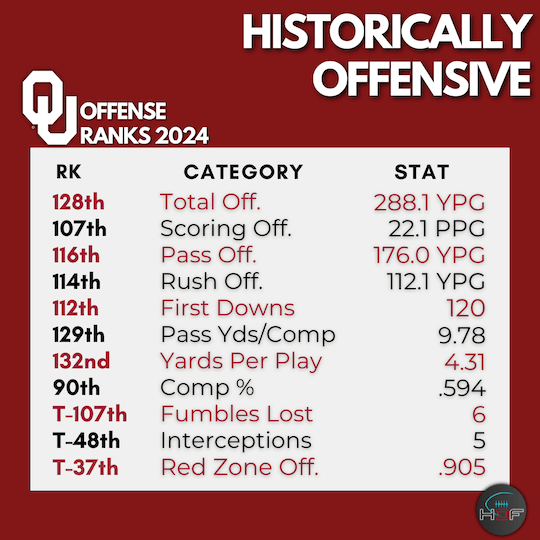
As a unit, this offense is drawing comparisons to the infamous John Blake era, and has the numbers to back the comparison up. ⬇️ ⬇️ ⬇️ ⬇️
There’s no other way to say it but bluntly … OU has no clear identity with its offense on the field.
The offensive woes go beyond play-calling; they’re structural. Reports from inside the Switzer Center suggest that there have been significant communication breakdowns within the offensive staff. Coaches have reportedly been on different pages regarding even the most fundamental elements, like blocking schemes. If those rumors are reaching the public, it’s safe to say Venables has known about these issues for some time.
A head coach — even a defensive-minded one like Venables — cannot allow such dysfunction to persist. These aren’t minor misunderstandings; they’re symptoms of a team struggling to find cohesion. Venables needed to address these issues early, before they became embedded in the team’s culture, but his delay in doing so has turned what might have been small fires into an inferno.
Mailed-In Hire: The Problem with Littrell
When Venables hired Seth Littrell, it felt like a placeholder decision. It wasn’t the bold, visionary hire that programs like Oklahoma should be making. Littrell’s track record showed some promise, but he had yet to prove himself as the kind of offensive mind that could elevate a program to championship contention.
Looking back on the decision to elevate Littrell and Finley, the hire seems more like an afterthought, a half-measure rather than a commitment to offensive excellence.
The results have been glaringly obvious. The offense lacks explosive creativity that OU fans are used to seeing, and that lack of energy has translated into downright unacceptable performances on the field, as evidenced by the Sooners’ historically bad statistical rankings in FBS football.
In just ten months on the job, Littrell and his offensive staff failed to the tune of numbers nobody in their right minds would have predicted following the Sooners’ 2023 season that saw the offense rank in the Top 5 in both Total Offense and Scoring Offense, and alone at the top of the Big 12 Conference in Points, Yards and Yards Per Play.
This despite having two of the most electric quarterbacks from their respective recruiting classes in the fold:
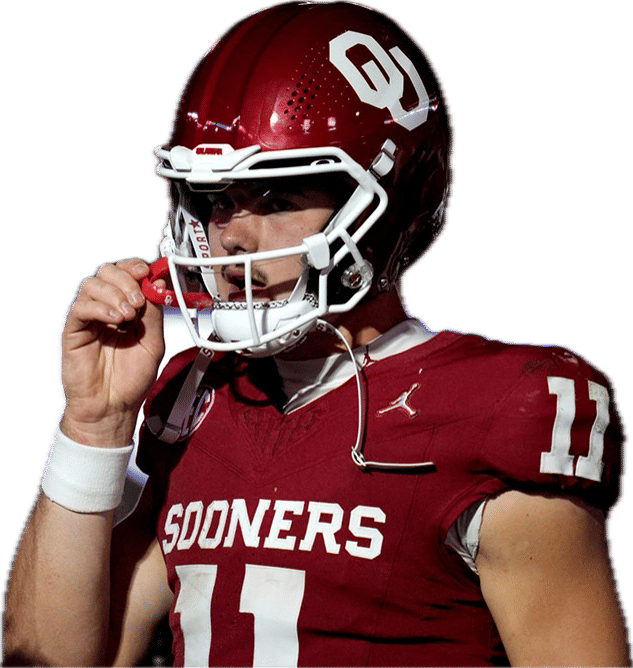
2023 5-star and Elite 11-winning Jackson Arnold of Denton Guyer, the 2023 Gatorade National HS Player of the Year and twice a Class 6A State Finalist in Texas.
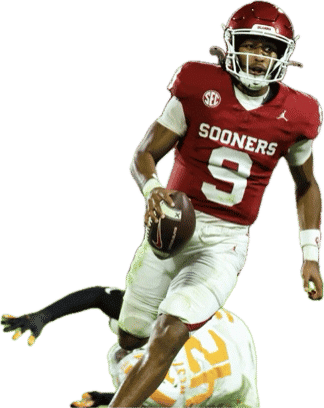
And former Allen and Frisco Emerson (Texas) superstar Michael Hawkins, Jr., a Sooner legacy trained by Kyler's father Kevin Murray, and who, as a senior, accounted for 55 touchdowns and just three turnovers, leading Emerson to within a game of playing for a Texas State Championship in Class 5A.
Neither were able to sustain success under Littrell's tutelage, and rumors have swirled this week about none of OU's QBs feeling as though been properly developed by the now-fired Littrell as the QBs coach.
Both started a games after being inserted for the other following ineffective play, and both came into their first appearances under Littrell with confidence and swagger that appeared missing by the time they were pulled from games after committing three turnovers and allowing the Sooners to fall behind teams they likely could have beaten were it not for the turnovers they committed.
In other words, Seth Littrell had to go.
Saturday’s loss leaves Oklahoma at 4-4, staring down a potential losing season -- the second for Venables since he arrived after the abrupt departure of Lincoln Riley to USC.
These are unacceptable at Oklahoma, a school with one of the richest football traditions in the country. What makes it even more alarming is that no longer can OU fans blame the losses on a ineffectice, suoddr defense — OU seems to have mostly turned the corner on that side of the ball — but to say the fan base is frustrated, would again be a massive understatement.
Oklahoma fans don’t want excuses; they want results. And for a head coach like Venables, the time for excuses is running out.
The Next OC Hire: BV’s Defining Moment
After Finally punting the Littrell experiment — once again needing more time than most believe he should have — Venables again finds himself in the market for a new offensive coordinator — for the third time in three seasons.
This time, though, the choice Venables makes will ultimately define his second tenure in Norman, possibly his entire future as a head coach in college football. Mailing it in would be tantamount to a dereliction of duty in the eyes of Sooner Nation.
Venables MUST get this one right. He has to bring in someone with a proven track record of offensive success, someone who can bring energy, innovation, and a clear identity to the offense. Anything less than a home-run hire will only deepen the cracks in Venables’ foundation as head coach.
If Venables fails to find the right offensive coordinator, his job security will slip through those cracks, and his tenure as the Head Ball Coach of the Sooners will die in a whimper. Even if he builds a defense that resembles the ’85 Bears, it won’t matter if OU’s offense can’t score points.
The OU fan base is patient to a degree, but they expect excellence. For Venables, this is a make-or-break moment.
Either he finds the right offensive coordinator and proves he can lead a balanced, championship-caliber team, or he risks being shown the door in a year or less.
The Venables Paradox: Championship Defense, JV Offense
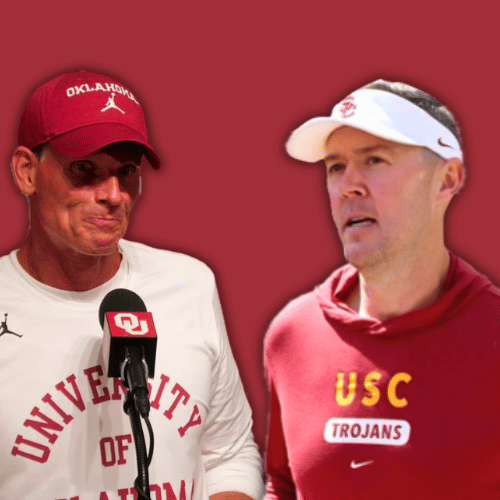
The irony of Venables’ situation is that, in many ways, Oklahoma has become Lincoln Riley’s reverse image. Under Riley, the Sooners fielded prolific offenses but were plagued by a porous defense that could never quite get them over the championship hump.
With Venables, it’s the opposite: the defense has shown promise, but the offense is currently in full-on spiral.
The head coach role, especially at Blue Blood OU, requires more than defensive expertise or recruiting prowess. It demands a complete vision, a well-rounded team, and an unwavering commitment to excellence on both sides of the ball.
For Venables to truly establish himself as a championship-level head coach, he has to be willing to delegate offense to someone who can make people forget he’s a defensive guru and simply call him “Coach.” To reach the heights that Oklahoma fans demand, Venables needs to be remembered not as a defensive mind but as a leader who fields a complete team. That requires taking risks, making tough decisions, and, most importantly, holding his staff to the highest possible standard.
It requires a decisive, confident vision for a championship future. The clock is ticking on Brent Venables’ tenure in Oklahoma, and his window for turning things around is narrowing.
Being the head coach at Oklahoma is an honor, but it’s also a responsibility. Venables needs to rise to that responsibility, or he and Lincoln Riley might both be in the job market this time next year.
________________
Jason Watkins is the Publisher at HOF Media Group and the Host of the HOF College Football Podcast. Reach him at jw@hofmedia.us