The Trinidad Chambliss Case and the NCAA’s Credibility Crisis
Judge Robert Whitwell ruled Thursday that Trinidad Chambliss met the NCAA’s own criteria for a medical redshirt.
That’s the headline.
But it’s not the story.
The story is that a circuit court judge in rural Mississippi had to spend one hour and 40 minutes reading a ruling from the bench to enforce bylaws the NCAA itself wrote.
I spent the entire day inside the Calhoun County Courthouse listening to arguments over whether Chambliss should receive a sixth year of eligibility — a season he lost in 2022 because of a medically diagnosed case of chronic tonsillitis.
What unfolded was more than a disagreement over eligibility.
It was a case study in institutional dysfunction.
The Evidence Wasn’t Speculative — It Was Documented
Coming into the hearing, much of the public reporting minimized the case. It was framed as if Chambliss simply dealt with a bad illness before fall camp at Ferris State Bulldogs football and failed to win the starting job.
That is not what the courtroom revealed.
Ole Miss and attorney Tom Mars presented 91 pages of medical documentation from Chambliss’ treating physician in Michigan. The diagnosis: chronic tonsillitis. The records showed recurring symptoms, sleep apnea, severe sleep disruption, and lingering effects dating back to his senior year of high school, compounded by prior battles with mononucleosis and COVID-19.
An expert medical witness reviewed those records and testified that he would have treated the condition similarly — and that, at minimum, the illness would have significantly limited Chambliss’ ability to compete for playing time in 2022. The physician further indicated that without medication providing relief in subsequent seasons, the condition could have continued to limit performance.
That testimony was clear, methodical, and rooted in documented evidence.
The NCAA countered with… no medical expert.
None.
Instead, one of the attorneys pointed to a line in a letter from Ferris State’s athletic director and argued it showed Chambliss simply lost a quarterback competition in 2022.
They then suggested that because Chambliss later won the QB1 job — after medical treatment and eventual tonsil removal — the illness must not have been serious enough to warrant a hardship waiver.
Those arguments contradicted each other.
Was he beaten out by a better quarterback?
Or was he healthy enough all along and exaggerating the severity of the illness?
Both positions were floated. Neither was supported by medical testimony.
At one point, the NCAA suggested that had Chambliss opted for a tonsillectomy in 2022, he might have been ready by Week 1 with three to four weeks of recovery time — a speculative timeline offered without a medical professional to substantiate it.
That kind of conjecture stood in stark contrast to the 91 pages of treatment records and live medical testimony presented by the petitioner.
The “Incapacitation” Argument That Doesn’t Exist
Perhaps the most puzzling aspect of the NCAA’s case was its repeated reliance on the word “incapacitated.”
The attorneys argued that Chambliss had not been “incapacitated” and therefore did not qualify for a medical hardship waiver.
There’s just one problem.
The NCAA’s own bylaws do not require incapacitation.
Per the NCAA handbook, the criteria for a medical hardship waiver are straightforward:
The injury or illness must be season-ending.
The injury must occur in the first half of the season.
The athlete must not have competed in more than 30% of the season’s competitions.
Documentation from a qualified medical professional is required.
“Incapacitation” appears nowhere in that language.
Yet the NCAA built much of its argument around a standard that does not exist in its written rules.
That alone raised eyebrows inside the courtroom.
An Uneven Fight
Ole Miss presented documented medical evidence and an expert witness.
The NCAA presented legal argument and interpretation.
No physician reviewed the 91 pages of records on the NCAA’s behalf. No competing medical testimony was offered. Instead, an affidavit from a fellow litigator was read suggesting that because Chambliss later competed successfully, the earlier illness must not have met the threshold.
When one side brings documented medical evidence and the other side brings no medical defense at all, the imbalance speaks for itself.
Even more perplexing, the NCAA did not request a change of venue. It did not seek to move the case to federal court. It did not request a different judge.
As one commenter astutely noted after the SEC Drive livestream I hosted with Marcus Dent of Ole Miss 365:
“The NCAA did not request a change of venue, did not request a different judge, and did not attempt to move the case to federal court. That kind of inaction is not accidental, it is a deliberate litigation strategy. The NCAA understands that repeated losses in state courts increase the pressure on Congress to intervene.”
Whether that theory proves accurate or not, the pattern is difficult to ignore.
Repeated courtroom defeats are steadily eroding the NCAA’s authority.
What This Means for Ole Miss
From a football standpoint, the impact is enormous.
Chambliss took over at Ole Miss Rebels football after an early-season injury to the starter and led the Rebels to an 11-1 record, two College Football Playoff victories, and a semifinal loss to Miami in the Fiesta Bowl.
With Pete Golding entering his first full season as head coach, Ole Miss believes it has:
One of the best quarterbacks in the country.
An elite running back in Kewan Lacey, who returns after rushing for 1,567 yards and 24 touchdowns last season.
A top-tier kicker.
A defense strengthened through portal additions.
Are they automatically a national title favorite? Maybe not.
But after losing a semifinal in the waning moments of the Fiesta Bowl, with Lacey returning and Chambliss back under center, Ole Miss belongs firmly in the contender column heading into 2026.
The schedule will test that belief. The margin for error narrows.
But with Chambliss in uniform, Ole Miss is not chasing relevance.
It is chasing a championship.
The Larger Problem
This case was never just about one quarterback.
It was about governance.
It was about whether the NCAA can apply its own rules consistently and competently.
When state judges are left to interpret bylaws because the governing body cannot convincingly defend its own decisions — especially without medical evidence in a medically based case — something is broken.
The NCAA is entrusted with protecting the integrity of college sports.
If this is the legal strategy being deployed to do so, the organization has larger problems than one medical redshirt waiver in Oxford.
Judge Whitwell didn’t just grant an injunction.
He exposed a credibility crisis.
And until the NCAA demonstrates that it can enforce its own rules with clarity, consistency, and preparation, courtrooms — not conference offices — may continue shaping the future of college athletics.
__________________________________________________________________________
Jason Watkins is the founder and creator of HOF Media and the HOF College Football Show on YouTube. Write to him at jw@hofmedia.us or on X (formerly Twitter).
The SEC transition has been harsher on Brent Venables and the Oklahoma Sooners than anticipated, with a tough 1-4 start sparking fan concerns over Venables’ leadership.
Despite glimpses of offensive progress in their latest 26-14 loss at Ole Miss, Oklahoma’s 4-4 record has fueled doubts about Venables’ ability to steer the program through the SEC’s relentless competition. While injuries to key offensive players have created challenges, Venables’ hesitance to address coaching issues and poor communication within the offensive staff have only deepened the Sooners' struggles.
The failure of the offensive staff to communicate effectively and Venables’ hesitance to manage his coaching staff proactively have compounded the difficulties presented by mounting injuries.
Hesitancy on Display: The 4th-Down Decision
Venables' hesitation was encapsulated on Saturday, just six days after finally relieving Littrell of his duties as offensive coordinator: the 4th-and-4 timeout against Ole Miss late in the third quarter. Trailing by two scores, Oklahoma needed a jolt to stay in the game.
The situation was critical, but hardly complex. Coaches make these calls instinctively, often without a second thought. Instead, Venables used a timeout — only to ultimately bring out the punt team, a decision that deflated the offense and left fans scratching their heads.
If the choice was to punt, Venables could’ve delayed the game for a mere five yards instead of burning a precious timeout. If he intended to go for it, why not get his new play caller’s best play for the situation and make the call confidently?
Even if the Sooners fail to pick up the four yards, it would have signaled a willingness to take a chance — or give one — to an offense that has been less-than-inspiring all season.
In that one instance, Venables’ hesitation was as costly as a missed play. With the momentum squarely in favor of Lane Kiffin’s Rebels, burning that timeout only to punt sent the wrong signal to a young group on offense that is in serious need of someone who believes in them. Instead, he proved he didn’t trust them to get a measly four yards and extend a drive to get back into the game.
OU’s Identity Crisis on Offense
What we’re witnessing with OU’s offense is not merely a slump — it’s an identity crisis. Oklahoma fans are accustomed to high-powered, fast-paced offenses that can score almost at will. Littrell’s offense was anything but explosive for seven weeks, and Joe Jon Finley had a lackluster, scoreless latter half of Week 8, too.
To say the Sooners struggled to establish consistency would be an overwhelming understatement.
OU has struggled with untimely penalties and turnovers and suffered through a complete lack of innovation and creativity. The plays feel uninspired, lack direction and are devoid of explosive results.
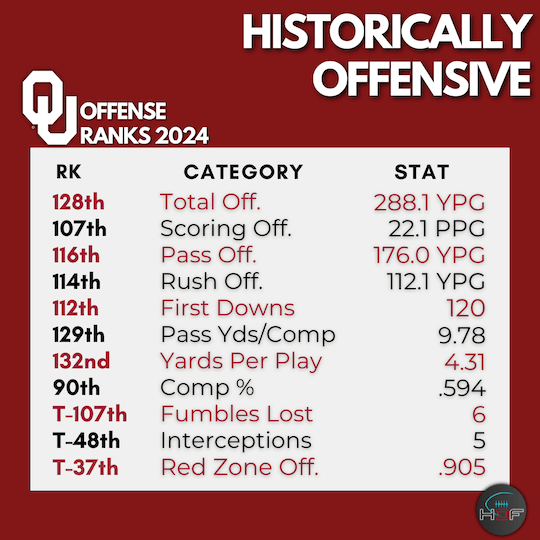
As a unit, this offense is drawing comparisons to the infamous John Blake era, and has the numbers to back the comparison up. ⬇️ ⬇️ ⬇️ ⬇️
There’s no other way to say it but bluntly … OU has no clear identity with its offense on the field.
The offensive woes go beyond play-calling; they’re structural. Reports from inside the Switzer Center suggest that there have been significant communication breakdowns within the offensive staff. Coaches have reportedly been on different pages regarding even the most fundamental elements, like blocking schemes. If those rumors are reaching the public, it’s safe to say Venables has known about these issues for some time.
A head coach — even a defensive-minded one like Venables — cannot allow such dysfunction to persist. These aren’t minor misunderstandings; they’re symptoms of a team struggling to find cohesion. Venables needed to address these issues early, before they became embedded in the team’s culture, but his delay in doing so has turned what might have been small fires into an inferno.
Mailed-In Hire: The Problem with Littrell
When Venables hired Seth Littrell, it felt like a placeholder decision. It wasn’t the bold, visionary hire that programs like Oklahoma should be making. Littrell’s track record showed some promise, but he had yet to prove himself as the kind of offensive mind that could elevate a program to championship contention.
Looking back on the decision to elevate Littrell and Finley, the hire seems more like an afterthought, a half-measure rather than a commitment to offensive excellence.
The results have been glaringly obvious. The offense lacks explosive creativity that OU fans are used to seeing, and that lack of energy has translated into downright unacceptable performances on the field, as evidenced by the Sooners’ historically bad statistical rankings in FBS football.
In just ten months on the job, Littrell and his offensive staff failed to the tune of numbers nobody in their right minds would have predicted following the Sooners’ 2023 season that saw the offense rank in the Top 5 in both Total Offense and Scoring Offense, and alone at the top of the Big 12 Conference in Points, Yards and Yards Per Play.
This despite having two of the most electric quarterbacks from their respective recruiting classes in the fold:
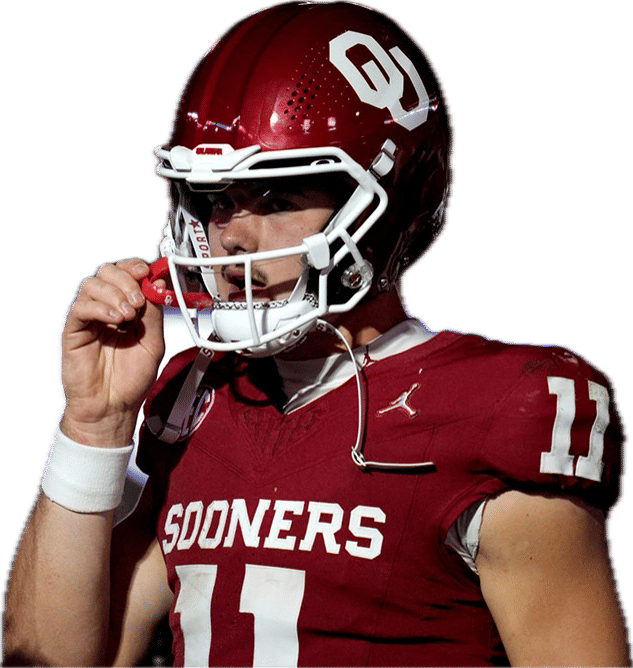
2023 5-star and Elite 11-winning Jackson Arnold of Denton Guyer, the 2023 Gatorade National HS Player of the Year and twice a Class 6A State Finalist in Texas.
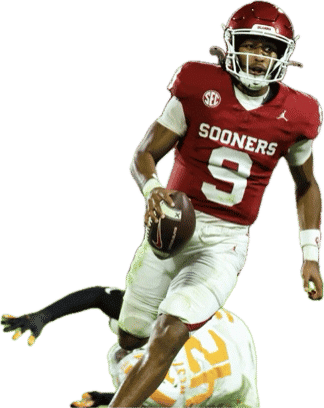
And former Allen and Frisco Emerson (Texas) superstar Michael Hawkins, Jr., a Sooner legacy trained by Kyler's father Kevin Murray, and who, as a senior, accounted for 55 touchdowns and just three turnovers, leading Emerson to within a game of playing for a Texas State Championship in Class 5A.
Neither were able to sustain success under Littrell's tutelage, and rumors have swirled this week about none of OU's QBs feeling as though been properly developed by the now-fired Littrell as the QBs coach.
Both started a games after being inserted for the other following ineffective play, and both came into their first appearances under Littrell with confidence and swagger that appeared missing by the time they were pulled from games after committing three turnovers and allowing the Sooners to fall behind teams they likely could have beaten were it not for the turnovers they committed.
In other words, Seth Littrell had to go.
Saturday’s loss leaves Oklahoma at 4-4, staring down a potential losing season -- the second for Venables since he arrived after the abrupt departure of Lincoln Riley to USC.
These are unacceptable at Oklahoma, a school with one of the richest football traditions in the country. What makes it even more alarming is that no longer can OU fans blame the losses on a ineffectice, suoddr defense — OU seems to have mostly turned the corner on that side of the ball — but to say the fan base is frustrated, would again be a massive understatement.
Oklahoma fans don’t want excuses; they want results. And for a head coach like Venables, the time for excuses is running out.
The Next OC Hire: BV’s Defining Moment
After Finally punting the Littrell experiment — once again needing more time than most believe he should have — Venables again finds himself in the market for a new offensive coordinator — for the third time in three seasons.
This time, though, the choice Venables makes will ultimately define his second tenure in Norman, possibly his entire future as a head coach in college football. Mailing it in would be tantamount to a dereliction of duty in the eyes of Sooner Nation.
Venables MUST get this one right. He has to bring in someone with a proven track record of offensive success, someone who can bring energy, innovation, and a clear identity to the offense. Anything less than a home-run hire will only deepen the cracks in Venables’ foundation as head coach.
If Venables fails to find the right offensive coordinator, his job security will slip through those cracks, and his tenure as the Head Ball Coach of the Sooners will die in a whimper. Even if he builds a defense that resembles the ’85 Bears, it won’t matter if OU’s offense can’t score points.
The OU fan base is patient to a degree, but they expect excellence. For Venables, this is a make-or-break moment.
Either he finds the right offensive coordinator and proves he can lead a balanced, championship-caliber team, or he risks being shown the door in a year or less.
The Venables Paradox: Championship Defense, JV Offense
The irony of Venables’ situation is that, in many ways, Oklahoma has become Lincoln Riley’s reverse image. Under Riley, the Sooners fielded prolific offenses but were plagued by a porous defense that could never quite get them over the championship hump.
With Venables, it’s the opposite: the defense has shown promise, but the offense is currently in full-on spiral.
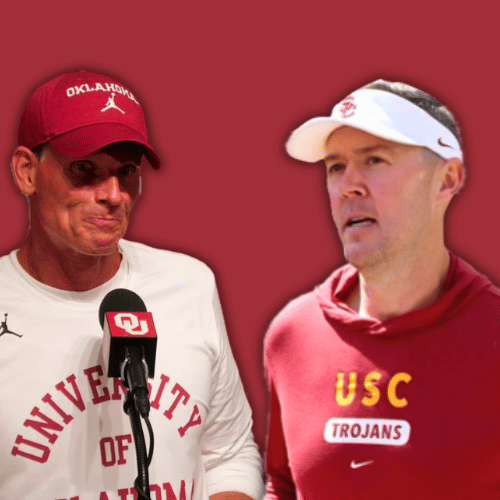
The head coach role, especially at Blue Blood OU, requires more than defensive expertise or recruiting prowess. It demands a complete vision, a well-rounded team, and an unwavering commitment to excellence on both sides of the ball.
For Venables to truly establish himself as a championship-level head coach, he has to be willing to delegate offense to someone who can make people forget he’s a defensive guru and simply call him “Coach.” To reach the heights that Oklahoma fans demand, Venables needs to be remembered not as a defensive mind but as a leader who fields a complete team. That requires taking risks, making tough decisions, and, most importantly, holding his staff to the highest possible standard.
It requires a decisive, confident vision for a championship future. The clock is ticking on Brent Venables’ tenure in Oklahoma, and his window for turning things around is narrowing.
Being the head coach at Oklahoma is an honor, but it’s also a responsibility. Venables needs to rise to that responsibility, or he and Lincoln Riley might both be in the job market this time next year.
________________
Jason Watkins is the Publisher at HOF Media Group and the Host of the HOF College Football Podcast. Reach him at jw@hofmedia.us